It was the final piece needed to complete the space in my Zen garden. We traveled to Redondo Beach, a city a little over an hour away to shop at a warehouse filled with casual furniture. I wanted something plain, non-fussy, and roomy enough to comfortably sit at least two people and maybe a few pillows. What we found was a rounded back, curved arm, slatted teak bench. Just perfect! It was a warm honey brown color, smooth to the touch with a fine grain running through it. Simple and aesthetically pleasing. Often chosen for its durability, teak has a high oil content that works as an insect, rot, and moisture repellant. Wow! Providing beauty, comfort, and side benefits – what could be better?!
From my journal: August 3, 2013, Newbury Park, California
“…sat in my Zen garden…so pleasant. Such a nice bench…the garden is so peaceful…”
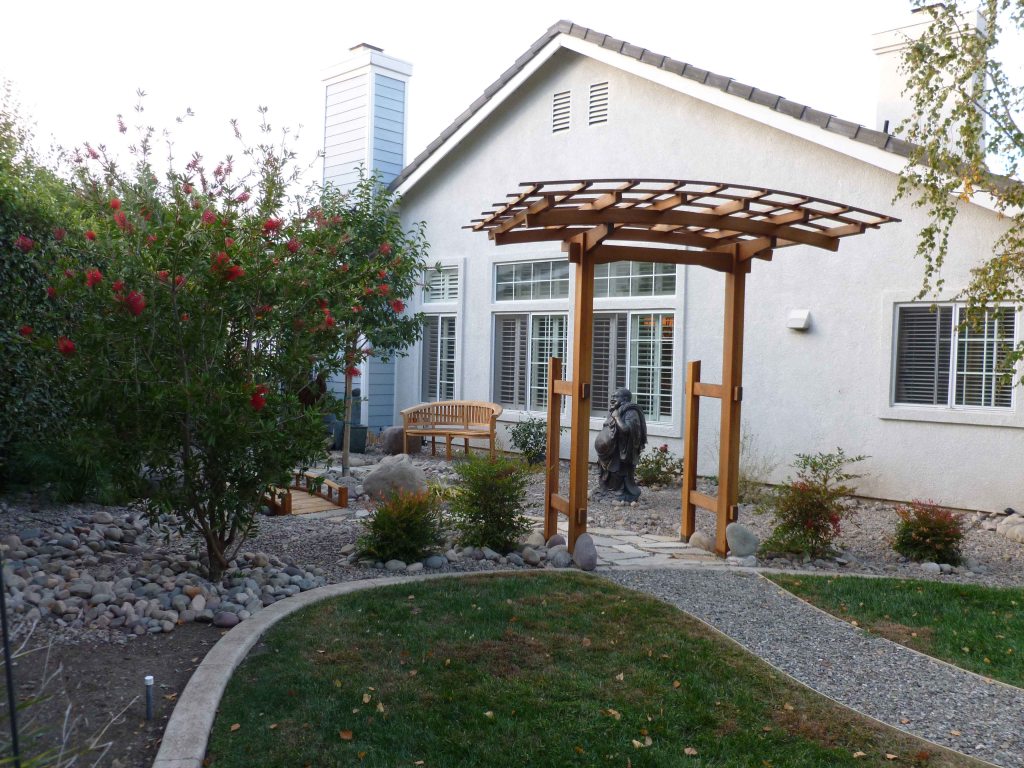
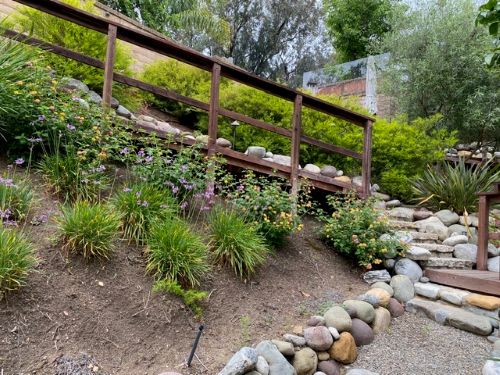
My bench was not only one of my favorite backyard resting spots, but our dogs liked it, too. At that time, our beagles Capers and Kashi would jump up on it and share the space with me. Snuggling together, I could see our brick fireplace and the grassy expanses with carved out pebbled paths. I could see the nandina bushes, succulents, and seedless olive trees covering our hill and two long wooden walkways that met at the top. I could see the table, four chairs, and a patio heater up there. Robert’s retreat. My bench offered me a great place to kick back with such a pleasant view.
Many mornings I’d bring my coffee and cozy up on my bench while the day was breaking. In late afternoons, I’d give my feet a rest and enjoy a cup of tea easing back into it. And Capers, he had yet another use for it. It was his spy deck! When I tutored students at our house, we’d sit in our dining room that looks directly out to my Zen garden. To avoid interruptions, I’d put the pups outside. Kashi was content to explore the yard, but Capers would climb on the bench and stare at us the whole lesson long!
While I don’t relax out there as often these days, when the pandemic hit, I did. Hanging out at home, I noticed a lot of things. The trees in my garden needed trimming, the succulents needed tidying, and my honey brown seat that had turned gray needed something…something like…paint! Like many others, quarantine time meant project time. So off to the hardware store I went. I found the aisle with Rust-oleum Ultra Cover All-In-One paints that ensured me that “no stripping, no sanding, and no priming” would be needed and that the product would “resist chipping and fading”. The only decision I had to make was the color. Hmm? Something bright. Something bold. Perhaps something more showy. Hunter green seemed just right.
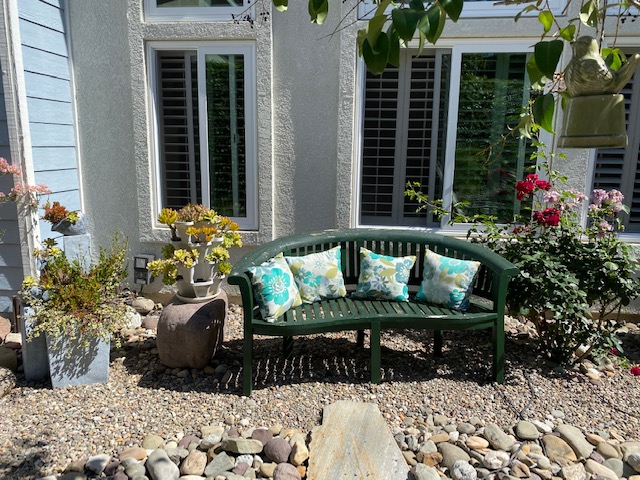
Laying down tarps, I readied my paint and brush, wiped off my bench, then turned it upside down and got to work. Two days later, it was done. I returned it to its rightful spot and placed pillows on top. Voila! A whole new look! It really stood out. Against the mostly muted greens, browns, and yellows of the plants, trees, and flowers, it called out, “Look at me!”
Look at it, I did. And a year later, while looking at it, I saw that the paint was peeling. Yikes! Immediately, I repainted it and not too long after, the paint chips fell where they may…again. Why? Was it the weather? The way I applied the paint? Without giving it much thought, I concluded that it must’ve been the paint. So, I scraped off the remaining flakes and decided to buy an Exterior Acrylic Latex paint in a different color. Something subtle. Something neutral. Perhaps something more natural. Beige seemed just right.
Repeating my previous steps, within two days, it had a whole new look…again! I set it back in its proper place. Another year went by, and this is when the saying about insanity came to mind. The one that says, “Insanity is doing the same thing over and over again and expecting different results.” Yup, that’s the one. You’ve probably guessed what happened. Yes, the paint was flaking off again, although the beige color did make it less noticeable. But, still.
This is when I googled “painting teak” and what came up should have been no surprise. It read: “Don’t do it!” Followed by, “Why ruin an expensive and beautiful piece of wood that possesses warm golden colors and delightful grain patterns?” Indeed. This particular article went on to give additional reasons, but for anyone bent on doing it, it laid out the process. To start, a teak cleaner would be needed to remove the dirt and surface oil. Next, a degreaser like acetone would be needed to remove the natural oils. Then, fine grit sandpaper would be needed to create a smooth surface. After that, a primer would be needed to keep the oil from bleeding through the paint. And, a high quality brush or sprayer would be needed to apply the paint in the direction of the grain. Whew! At the end of the instructions was a disclaimer. It reiterated the reasons for not painting teak – mainly, why mask its beauty?
And there we have it. I didn’t follow all the steps needed to correctly paint my teak bench, and I have to say, I’m so glad. I know my bench is an inanimate object, but I almost feel it wanted to return to its natural state by shedding all its coverings. When I am in my Zen garden now I can see much of the beige paint has worn off it. And now I can see my bench in a whole new light. No longer a honey color, it has a silvery gray patina. Its grain is still prominent and it’s still soft, even soothing to touch. Yes, it’s weathered, and it’s aged, but it shows its authentic appearance, its true essence, its original character. It blends nicely with its outdoor surroundings. And once again, it exudes its beauty, its natural beauty for all to see.
 A Journal Journey