
Maybe it stems from the social etiquette I learned growing up. Manners like maintain eye contact with the person speaking to you, keep elbows off the table, hold the door open for the person behind you, be on time, and answer questions when asked, are ingrained in me. For most of my life, it’s the last one that has caused me so much pressure, so much stress. Why? Because I don’t have all the answers. Why should I pretend that I do? And trying to be polite, respectful, and answering out of obligation hasn’t always turned out in my favor.
This became very apparent in my first year teaching. This is when I learned not to answer a question off the top of my head. Who knew that students went home from school everyday repeating what their teachers said?
A few questions that I answered inadequately or more so inaccurately, were ones you’d think were easy. For instance, a first grader once asked, “If you say we’re all special, how can everybody be special when special means just a few?” To that I might have answered, “I mean unique.” The kids who were unfamiliar with that word nodded, and the ones who were familiar with it, shrugged. During art, a student asked, “If glue sticks things together why doesn’t it stick to the inside of the bottle?” To which I may have replied, “Oh, it’s because of the material inside.” A moment later I heard, “But there’s glue stuck to the outside of the bottle…isn’t it made out of the same stuff?” To that may I have joked, “Ha! What a sticky situation!” And when teaching our weather unit, I was asked, “When does it go from partly cloudy to partly sunny?” To that I probably said, “If the sky looked cloudy when you woke up and then the sun came out, that’s when.” At the time, I wouldn’t have even thought about being honest and saying, “Beats me!”
Why do people often feel compelled to have all the answers? Maybe like me they’ve been conditioned to answer any and all incoming queries. However, there are psychological reasons that may help explain this need to be a Know-It-All.
One reason is that our culture seems to reward speedy and confident responses. It’s something that is expected, even though some answers while given fast, may be incorrect. Also, many people operate in “fixer” mode so when a question posing a problem arises, they want to solve it right away instead of exploring alternative options.
There’s the idea of security. too. We live in a world of unpredictability, so having an answer can make us feel in control. This goes hand in hand with the fear of appearing weak or uninformed, especially in a professional or work setting. In this case, people may want to present themselves as all-knowing to gain respect or status. And there’s also cognitive habits, like not pausing to think things through and not evaluating the source of the information we pass on. And of course, there’s that uncomfortable feeling we may get when we don’t want to admit we don’t know something, so we avoid it by blurting something out.
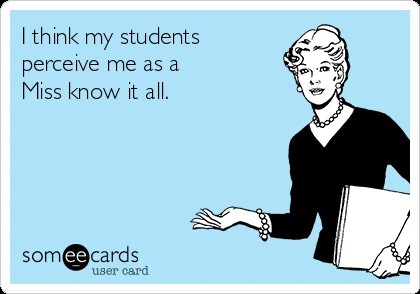
Once I became aware of what I was doing, and not wanting to do a disservice to the children I was teaching, or worse yet, not wanting to be cornered in the school parking lot by a parent saying, “My child told me you said…” that’s when I embraced a three-point plan to cure myself of the Know-It-All Syndrome.
First, I began using more humor when responding to a question that stumped me. I might say, “Ha! That’s a good question! If only I was a (fill in the blank of an expert here)!” If that didn’t work, I could always turn the question back to them saying, “Why do you ask? What do you think?” which would buy me a little more time and would help me understand what was really being asked so my response would be more meaningful. And if those two approaches didn’t work, I’d simply say, “I don’t know,” as evidenced by my journal entry many years after I started teaching.
From my journal: November 24, 2014, Newbury Park, California
“…had to laugh…kids think teachers have the answers to everything!…D. said he couldn’t believe I said I didn’t know…”
My teaching days are behind me now, but I still use this approach anytime, anywhere, and with anyone who lobs a question at me that I am unsure of. What a relief! No more pressure, no more stress, and no more Ms. Know-It-All.

