
Today begins my second month of implementing a relaxation technique on my year-long Quest for Calm. Before I get to that I want to tell you about my February’s deep breathing experiences. I am happy to report that yes, all three types of deep breathing were successful in helping me relax, feel less anxious, and simply chill! At least three times a week, four times a day, I practiced one of the three exercises I outlined in my blog post “A Gift of Life”. First up was Nadi Shodhana Pranayama or Alternate Nostril Breathing. I got the hang of it again after a few rounds. I liked that I could do this exercise at my desk or in a chair. And it centered me immediately as I had to focus on toggling my hand from one nostril to the other. The only draw back for me is that I’d feel self-conscious using this technique in public, say in a waiting room where I like to calm myself before appointments. The Sitali Breath worked well, while sitting, standing, or even lying down. This was one I’d also feel most comfortable practicing at home. I found Box Breathing was easiest to do, can be done in any position, and best of all, can be done anytime and anywhere!
In evaluating all three I not only recorded how I physically and mentally felt after my practice, but I wanted to quantify what was happening. To do this I made note of my heart rate on my FitBit watch before and after my practice. Without exception, my heart rate slowed bringing it closer to my resting rate. One more thing to note is not only did I practice these exercises, but I put them to use numerous times when I felt stressed or challenged by events, especially ones out of my control. Ah…what a breath of fresh air!

Now to tell you about my relaxation choice for March. Just like deep breathing, I will be practicing this one on a regular basis. Because I am in the habit of putting my thoughts on paper, I’ve decided to create affirmations! I’ve used this technique often in the past, but it has been many years since I’ve engaged it in. Affirmations are positive statements that you write and say aloud to keep yourself focused on a specific goal. Previously, I have written affirmations regarding self-care, communication, and creativity.
From my journal: July 27, 1995, Fountain Hills, Arizona
“Grateful that I am constantly learning about myself and have tools to cope with new situations and people…rewrote my affirmations…my first is to be kind and gentle with myself right now…”
The way affirmations work is that by writing and saying positive statements often, your thought patterns shift and the narrative in your mind changes. You then begin to focus on optimistic, healthy thoughts rather than pessimistic, anxiety-ridden ones. Over time, these statements become your beliefs, so you think and act differently. People can essentially rewire certain thoughts through their use. Positive thoughts create positive actions. Very empowering, I’d say!
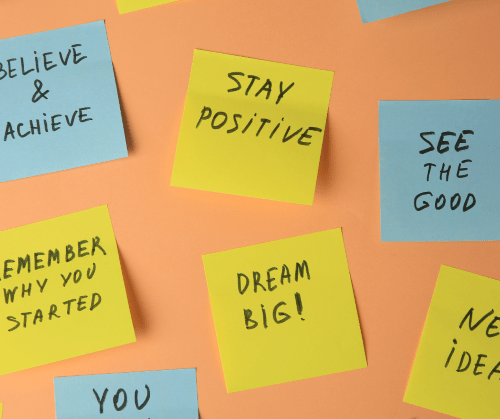
Rules for constructing affirmations are straightforward. First, choose an area in your life you’d like to improve. The area I want to continue working on is handling stress better and keeping calm. Second, make sure it’s a change that is realistic and achievable. I already know from last month’s experience, that my goal is possible. Third, write the affirmation concisely, in the present tense, and by hand. Start each statement with “I am” which assumes you are already experiencing what you want to have happening in your life. Make each one short and specific. Then write them out by hand. Why? Because putting your thoughts down on paper transforms them from abstract ideas to concrete ones. In written form, affirmations are visual cues that help you record messages and store them in your memory bank. And the fourth rule is when you say your positive statements, say them with feeling!
The three affirmations I will be implementing in March are:
I am calm and relaxed.
I am able to handle whatever comes my way.
I am inhaling peace and exhaling worry with every breath.
I’ll record each affirmation three times in my journal every day and will say them aloud. Then I’ll note the results. Am I ready to begin? Why yes! That is affirmative!
 A Journal Journey